I’m guest posting over at the fantastic All About Worship website today. A fellow worship leader friend of mine recently said to me “I’d sacrifice my contemporary music in order to be united in worship as a church body any day.” I’m sharing some follow up thoughts in the guest post. Take a moment to stop by!
Archives For Ryan Egan

We’ve already looked at the general structure of a lead sheet as well as building basic chords. I wanted to take some time to say hi through video and show you how helpful inversions can be while playing from a lead sheet. Take a look at the video above for a closeup look.
(By the way, this is my first attempt at video and I don’t have amazing equipment yet. If anyone wants to donate a FlipHD to a worthy cause of making more videos like this, I’d be most grateful! :-))
The lead sheet I used in this video is Jesus, Thank You from Sovereign Grace music and can be downloaded for free here


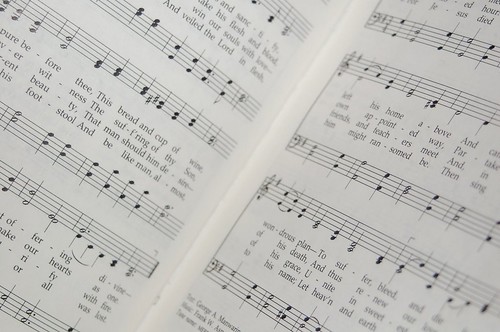
Do you have a process that you utilize to chose the songs and hymns you use for a worship gathering? Or is your decision-making arbitrary or based on the fact that you just “like the songs?” It’s very important to have solid reasons for choosing the songs that you choose. Here is my process:
First and foremost: Is God, in all of His nature, revealed clearly?
The most important criteria when choosing a selection of songs is that God is represented clearly and accurately. This includes:
- His grace (He has offered this help to us freely)
- His wrath (songs we pick must help drive home the point that we are sinners in need of His help)
- His triune nature (try to make sure the Father, Jesus, and the Holy Spirit are represented)
- His attributes (we obviously can’t mention every single one of His attributes in song every gathering, but songs must clearly show one or more of them)
Are the Songs Singable?
- Is the key appropriate and attainable for the average singer?
- Do the rhythms work well in your congregation’s demographic?
- Would the lyrics take too much time to explain or are they self-explanatory? (“Here I raise my Ebenezer” or “like a sloppy wet kiss” being examples from both traditional and modern music that would need to be explained)
Will the Songs be Sung by all Generations?
In our case, we have a very multi-generational worship setting. I want the songs that are picked to be able to be sung boldly by both the seasoned and the youth of our congregation. Youth should be expected to have an appreciation for hymns and, in the same manner, the older generation should be expected to have an appreciation for the modern music of our culture.
As I pick songs for worship gatherings I want them to give an accurate picture of God’s entire nature, be singable, and be proclaimed by every generation.
What is your process for choosing songs for worship?
(photo by MissBee on Flickr)

When Joe Day contacted me to ask if I would like to review his album I was expecting it to be good. However, what I didn’t expect it to be was phenomenal and breathe as much life lyrically and musically into my collection as it has.
A Joyful Journey to Grace
Joe takes the listener on a grand journey from sin and death to redemption and life. “Death to life,” the first track on the album, sets the tone for the rest of the picture the album paints. Joe uses this first track as the beginning of several times of making Scriptural accounts deeply personal: “I was a prodigal son…I was a wondering sheep…I was at war with You…I was a whitewashed tomb.” The words we see applied to the characters in the Bible that we say “we’ll never be like” are staring us in the face and causing us to realize that we are more like the Prodigal, the lost sheep, and the Pharisees than we care to admit. But God is good, and as Joe triumphantly proclaims, “You are my salvation. You are my redemption.”
Powerful and Surprising Music
The rest of the songs on the album are beautifully crafted, produced, and executed, with a surprising and altogether refreshing sound for a worship album. While there is a place for popular music from radio-released worship leaders, I love the fact that Joe himself says that this “album doesn’t sound like it came out of Nashville.”
The instrumentation is fantastic. Joe makes use of many surprises within his great, gritty Seattle rock sound. The album includes subtle piano underscores; extremely surprising but perfect, lush, and rich trombones on “A Prayer for Faith”; violin and cello on many pieces, and powerful traditional organ mixed with vibraphone, chimes, and driving electric guitar on the climactic “Christ is Risen.” Sounds from Aaron Sprinkle to Arcade Fire can be heard throughout the album.
Singable Songs and Fresh Lyrics
While all of these songs are definitely singable, some would find their way into a typical congregation a little easier than others. In particular, the verse to “At the Foot of the Cross” was instantly in my head and sung throughout the day. “The Glory of God” unites worshipers past, present, and future into realizing how finite we are: “What can I give unto You, my Lord, for You are of infinite worth.” The lyrics also proclaim God’s rule over time and space: “The deepest parts of the universe are not strangers to Your hand.”
While Joe includes many musical surprises, the lyrics are no exception. “Passover” takes the literal account of the original Passover event and applies it directly to the worshiper’s life. “Pass over me, let your wrath pass over me.” While we do not have to fear losing our first born or the promise of Salvation at the Cross, the lyrics make a pointed effort to still give up many of our own “firsts” to which we tend to cling: “Take the first of my time, take the first of my mind, take the first of my heart.” “What Have we Done” includes the shocking lyric “Judas sold you for thirty. I’d have done it for less,” forcing us to wrestle with just how human we truly are.
Creative Commons Solves a Major Issue
Perhaps the greatest part about this album is that Joe decided to use a Creative Commons Attribution Non-Commercial 3.0 License. Churches don’t need to have a CCLI license to use the music from the album legally. And, how many times have I wished I could burn a practice CD for my worship team members! Joe solves that problem by using Creative Commons, allowing worship leaders to share digital copies of the music for the purpose of learning the songs.
One Complaint to a Stellar Collection of Worship Songs
My only complaint with Grace is that while all of the songs are singable in certain settings, the typical contemporary church might have a hard time picking up some of the melodies and the range of those melodies. However, this album is a must-have for any personal worship music collection and a good amount of the songs are in fact, very easily singable and great for many congregations.
You can purchase the album on iTunes, Amazon, or NoiseTrade. You can follow Joe on Twitter, visit the official Joe Day music website, or find him on Facebook.
This album has quickly become one of my new favorites. What’s one of yours?
Previously we learned how to look at the key signature, rhythm, and structure of a lead sheet. This time we’ll take some time learning how to build chords and understand chord names within a lead sheet. Take a look at the video to learn how (email readers, you’ll need to visit I am an Offering to view the video).
I’m beginning to build a page full of helpful sheet music that you can feel free to download and use. The common chords and inversions sheet music can be found there.
What are some common struggles you have faced when learning to read and play from a lead sheet?
The lead sheet I used in this video is Jesus, Thank You from Sovereign Grace music and can be downloaded for free here.