Archives For Training

The most common thing I encounter when working with piano players in a church is that they are usually classically trained. This is a good thing and classical training on the piano should never be lost. However, in learning how to play modern worship music styles, piano players need to shift from being a piano player to a keyboard player. For more detailed information on this, visit this post and this post, but for now, what are some basics of being a keyboardist on a modern worship team?

  • Learn to play chords and learn how to play inversions of those chords. You’ll not only create much more pleasing sounds, but you’ll save yourself from jumping all over the keyboard to get to your next chord.
  • Listen and learn to play in the cracks. Listen to where there are gaps in the melody of the song and learn to add short and simple fills in that time. Don’t play fills over the melody. Listen to the other players in the band and communicate who will be adding a fill where. Don’t play over each other.
  • Apply classical teaching to create fills. Remember all of that Mozart and Beethoven you learned? Much of classical music is made up of melodies that use notes that pass from one key note to another, called “passing tones.” Learn to apply these concepts to creating fills. Get away from just breaking up the three notes of a chord and use some passing tones to create more interest.
  • Listen some more and learn what register to play in. If the guitarist is playing in a middle register, play up high. If the guitarist is playing in a high register…you guessed it…play down low. If you an electric guitar playing high and an acoustic guitar playing in the middle, sit out and only play fills in the cracks of the melody.
  • Know when to sit out. Piano players tend to be the ones that play the most often. Learn when to play out and when to hold back. If you’re unsure, ask your worship leader.
  • Practice. Practice. Practice.

One of my main goals for this blog was to always provide training for worship leaders and worship teams that is practical and easily usable.  So next week, we’re going to dive back into some training.  We’re going to take a look at some basic, foundational things to know and apply with each instrument in the worship team and then take a look at how to put it all together.  Often times in church worship teams we have a lot of people who are excited to serve but might not even know the basics about playing their instrument within a group.  So, next week will look like this:

  • Mon – Back to Basics: Piano & Keyboard
  • Tues – Back to Basics: Acoustic & Electric Guitar
  • Wed – Back to Basics: Bass Guitar
  • Thurs – Back to Basics: Drums & Percussion
  • Fri – Back to Basics: Putting it all Together

We’ve all been there. We’ve known how to sing for a long time and now we’ve just started learning how to play an instrument. We learn how to play that instrument and think, “Hey, I should try to sing and play at the same time.” The first few tries are….interesting. Eventually we get the hang of it. But then we reach another fork in our musical road: talking and playing at the same time.

It sounds easy doesn’t it? But the difference between singing and playing and talking and playing is that when you sing and play, the rhythm of your voice somewhat matches the rhythm your playing (hopefully :-). When you talk and play, however, the rhythm of your voice is completely different.

First of all, why would you even want to do this?

  • A simple vamp underneath prayer time gives a great amount of focus. You might want to be able to pray and play at the same time.
  • Often it’s good to pause in the middle of a song to remind or encourage people to think about the words. Instead of stopping the song in the middle and then restarting, you can vamp through the chorus or turn while you’re exhorting the people.
  • If you’re not an “up-front” worship leader and your “just” (I use that word very lightly, as all team members are super-important) a piano player or drummer or bass player, you might want to learn to pray while you play for your own personal worship times, or to be able to confess a creed or the Lord’s Prayer while you are playing. I remember one piano player telling me that she always lost where she was in the music when she tried to play and say the Lord’s Prayer at the same time! 🙂

So, how can you develop this and move past this hurdle in your musical career?

  • Practice. I should see if I can count how many times I’ve typed that word on this site! Pick two chords to vamp and pray while you are practicing. Then when you’re comfortable with vamping two chords and talking, add another, then eventually get to a four-chord progression*.
  • Watch. Watch others do this. If you can get your hands on some of Paul Baloche’s live videos, he’s particularly good at this.
  • Know your music. If you’re planning on talking or praying in the middle of a song, know your music like crazy. Get to the point where you don’t even have to think about the next chord of the song, but that it comes naturally. You do this by…you guessed it…practicing! 🙂
  • Plan with the band. It’s nice when one instrument is vamping and someone is playing or talking, but it’s even better when the whole band or team is vamping together. A bass player can play nice, non-distracting melodic lines underneath, and once your comfortable, the band can change dynamics with the mood of the prayer, praying along with the person praying on their instruments. Don’t just play, make your playing an extension of prayer.
  • Don’t do this publicly until your ready. Make sure to wait until you are completely confident in doing this until you do it during a public worship service. Start privately, then maybe try it out in your small group, then when you feel comfortable, go ahead and do it for the worship service.

If you practice and practice and practice and you just can’t seem to get the hang of talking and playing at the same time, let the band do the playing while you talk. Give the band a chord progression to play and make sure they know it well, then let them do that part while you focus on talking or praying.

*I will be doing some blogging on chord progressions sometime soon. We all know that vamping two chords gets pretty boring after a while!

Skill Lids

Ryan Egan —  March 21, 2008 — 7 Comments

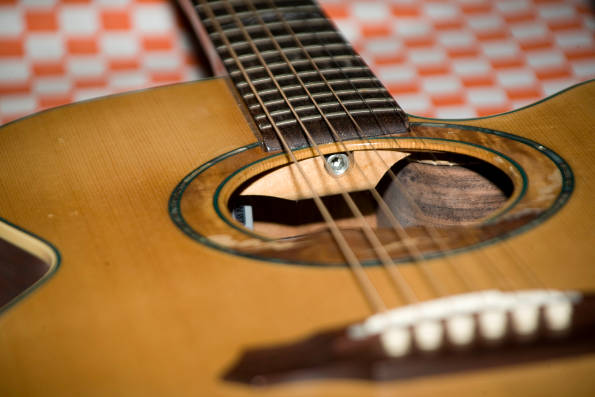
Image of an acoustic guitar on a checkered surface

One of the things that can keep a congregation from worshiping God is being distracted by unprepared musicians or teachers. What are some things that keep us from getting more skillful at our instrument or voice technique?

  • Lack of desire to get better. This can come from thinking that you’re already good enough or it can come from believing that it doesn’t matter to do things with skill and that “God accepts us just the way we are.”  While that is true, it is a Biblical concept to play with skill and also a Biblical concept to do things to the best of our abilities, doing everything we do for the Glory of Jesus.  There is always room for improvement and it is so important that we are life long learners.   If you are struggling with a lack of desire to get better, you might want to take a listen to this great message from Ken Boer and Pat Sczebel.
  • Not practicing.   So many worship team members think that it’s okay to just show up for rehearsal without preparation and then show up for the service without practicing.   Why do we expect the pastor to spend literally hours upon hours preparing for the message but we’re fine with the musicians putting in only practice with the team but not any personal preparation?  Not only does practicing make you a better player or singer, it’s makes you less of a distraction during a meeting because you are confident at what you’re doing and can look like you’re enjoying yourself and worshiping God instead of being buried in the music.
  • Not listening to a variety of styles and genres, or just plain not listening to anything.  It is so important that we constantly listen to music for inspiration and examples.   Listen to new songs, listen to old songs, listen to rock songs, listen to jazz songs, listen to chant, listen to everything you can listen to (as long as it does not focus your mind away from God with its message.)  Pick out your specific instrument or listen closely to how the vocals blend.
  • Along with that, we limit our skill by declaring that we only like a particular style of worship.   It is just as dangerous to proclaim that we can only worship “contemporary” music as well as proclaiming that we can only worship with hymns.  Take in both and take in a lot of both.

Can you think of any more skill lids?

(photo by Matt Gruber)

I usually don’t post twice in one day but our pastor has just started a blog series that I think will be very beneficial for believers to read. I blogged last weak on the importance of knowing how to defend what we believe. This is what Wade is going to be diving into this week. Check out the first post here.